Helbing, D., Mahajan, S., Fricker, R. H., Musso, A., Hausladen, C. I., Carissimo, C., … Dubey, R. K Pournaras, E. (2023). Democracy by Design: Perspectives for digitally assisted, participatory upgrades of society. Journal of Computational Science, 102061.
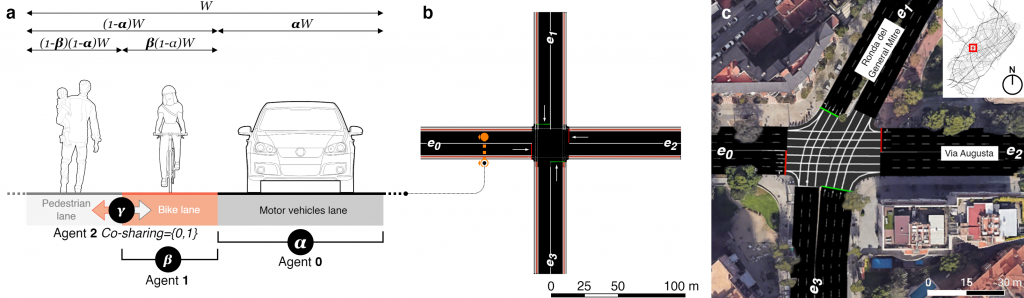
(a) Example of street layout foreseeing seperate rights of way (ROWs). (b) Synthetic 4-arm intersection with four outgoing and four incoming edges. (c) Intersection of Via Augusta with Ronda del General Mitre extracted from the street network of a traffic digital twin of Barcelona. For this research, this layout was modified to allow for adaptable lanes and mixed traffic (vehicles, cyclists and pedestrians). Inset: Location of the intersection in the city.
With the rapid increase in the percentage of the world’s population living in cities, the design of existing transportation infrastructure requires serious consideration. Current road networks, especially in large cities, face acute pressures due to increased demand for vehicles, cyclists, and pedestrians. Although much attention has been given to improve traffic management and accommodate the increased demand via coordinating and optimizing traffic signals, research focused on adapting the static allocation of street spaces and right-of-way dynamically based on mixed traffic flow is still scarce. This paper proposes a multi-agent reinforcement learning (RL) agent approach that cooperatively adapts the individual lane widths and right-of-way access permissions based on real-world mixed traffic flow. In particular, multiple cooperative agents are trained with mixed temporal data that learn to decide suitable lane widths for motorized vehicles, bicycles, and pedestrians, along with whether co-sharing space between pedestrians and cyclists is safe. Using a microscopic traffic simulator model of a four-legged intersection, we trained our RL agent on synthetic data, and tested it on realistic multi-modal traffic data. The proposed approach significantly reduced average waiting time by 73.3%, 5.9%, and 36.6% and reduces the average queue ength by 56.1%, 4.4%, and 36.9% with respect to Static, Heuristic, and PPO-based adaptive models, respectively. Moreover, the model learned to adaptively toggle co-sharing of the street space between cyclists and pedestrians as one co-shared lane, keeping the comfort and level of service in accordance with the designer’s policy.